
The honeymoon phase of vibe coding is over.
We’ve all had that “magic” moment: you prompt an AI, and a complex React component appears instantly. It feels like the end of manual labor, or even coding. But for most developers and founders, that magic eventually hits a wall. You spend hours “vibing” with an LLM, only to realize that the code it generated is a house of cards. One small change in a prompt causes the entire application to either break or completely derail from your original idea.
At Sleek App, we’ve seen this pattern repeat across dozens of projects. The truth is simple: Vibe coding fails because it lacks a feedback loop rooted in human-defined reality. Without a proven TDD framework, you aren’t engineering; you’re gambling with what AI thinks you want. To turn a vibe-coded app into a production-ready product, you must transition from guess-driven development to agentic engineering.
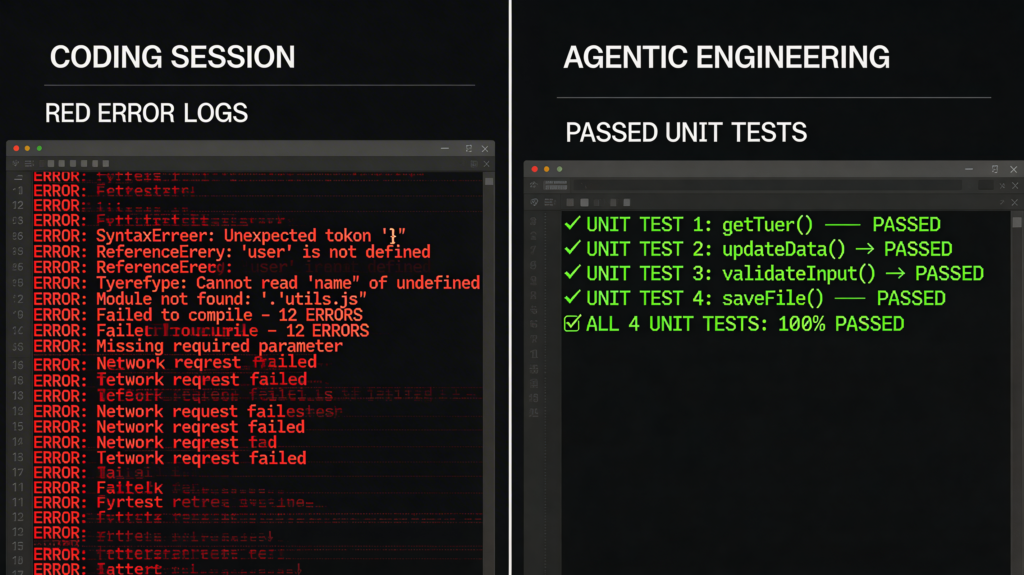
1. The Vibe Coding Trap: Why LLMs Hallucinate Failure
The real reason vibe coding fails is a lack of concrete constraints. LLMs are probabilistic: they predict the most likely next word, not the most correct logic. When you ask an AI to build a feature, it guesses. If your prompt is slightly ambiguous, that guess becomes a hallucination.
In a traditional AI-augmented coding workflow, the human developer catches these errors. But in a vibe coding workflow, the developer often just asks the AI to simply “fix it.” This creates a feedback loop of hallucinations. You’re trying to fix a bug with a guess, which creates another bug, until the technical debt is so high that the AI itself can no longer understand the codebase.
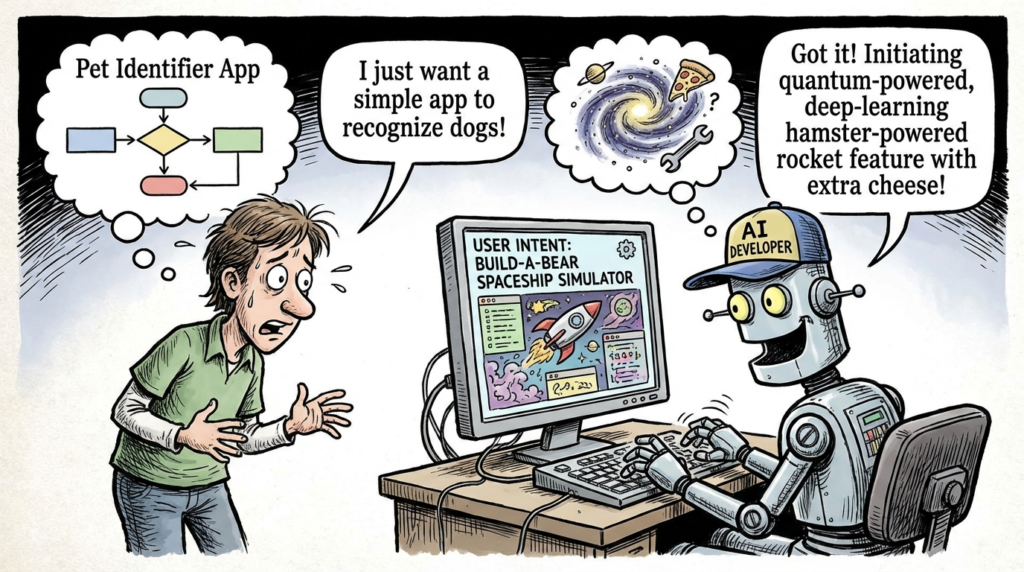
At Sleek App, we learned to prevent this failure by using Test-Driven Development (TDD) as the ultimate prompt engineering companion. A test isn’t just a check; it’s a non-negotiable requirement that forces the AI to stop guessing and know exactly what we want.
2. TDD: The Only Proven Framework for AI Agents
If you want to move from “vibing” to professional AI app fulfillment, you need a framework that can handle the guesswork of AI. Test-Driven Development is that framework.
When you are coding with AI agents, you are managing a workforce that is incredibly fast but lacks common sense. By writing the tests before the AI generates the code, you provide the “Common Sense” in the form of test suites. This framework ensures:
- Elimination of Ambiguity: A test suite tells the AI exactly what success looks like. No more guessing.
- Regression Protection: In a vibe-heavy environment, it’s easy to fix one bug while breaking three others. A TDD framework catches those regressions the second they happen.
- Precision: We move the AI from the realm of “creative writing” into logical fulfillment.
This is the core of agentic engineering. We don’t just prompt an AI chatbot; we build a system where the AI is physically unable to submit code that doesn’t meet the business requirements.
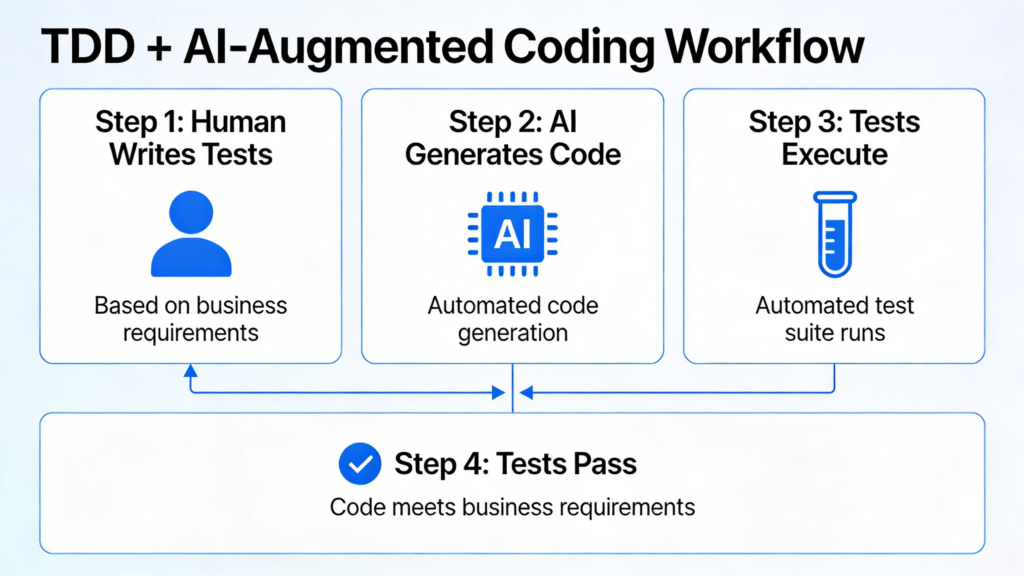
3. The Rise of Agentic Engineering and Workflows
We are moving past the era of “Chat with AI” and into the era of agentic workflows for devs. This involves autonomous agents that don’t just write code, but research, test, and refactor it.
However, an agent is only as powerful as its guardrails. Without TDD, an autonomous agent can “hallucinate” success. It might change a database schema to make one function work, while accidentally breaking five others. At our AI software development agency, we treat TDD as the “leash” for these agents. It allows them to work at speed while ensuring they stay within the boundaries of the business’s logic.
4. The Human Element: Strategy over Syntax
If AI can handle the coding, what is the engineer’s job? Simple: Strategic Architecture.
Test-Driven Development is where the human thinking happens. You can’t automate the understanding of a complex business case. At Sleek App, we use our 10+ years of engineering depth to ask the questions the AI isn’t programmed to ask:
- “What happens to the user’s data if the payment gateway times out?”
- “How does this custom AI automation service scale when we hit 100,000 requests?”
We translate these strategic requirements into test suites. While we use prompt engineering for software to help scaffold the tests, the human remains the final authority. We ensure the tests reflect the business need, not just the syntax.

5. Technical Guardrails: Vitest vs Playwright AI
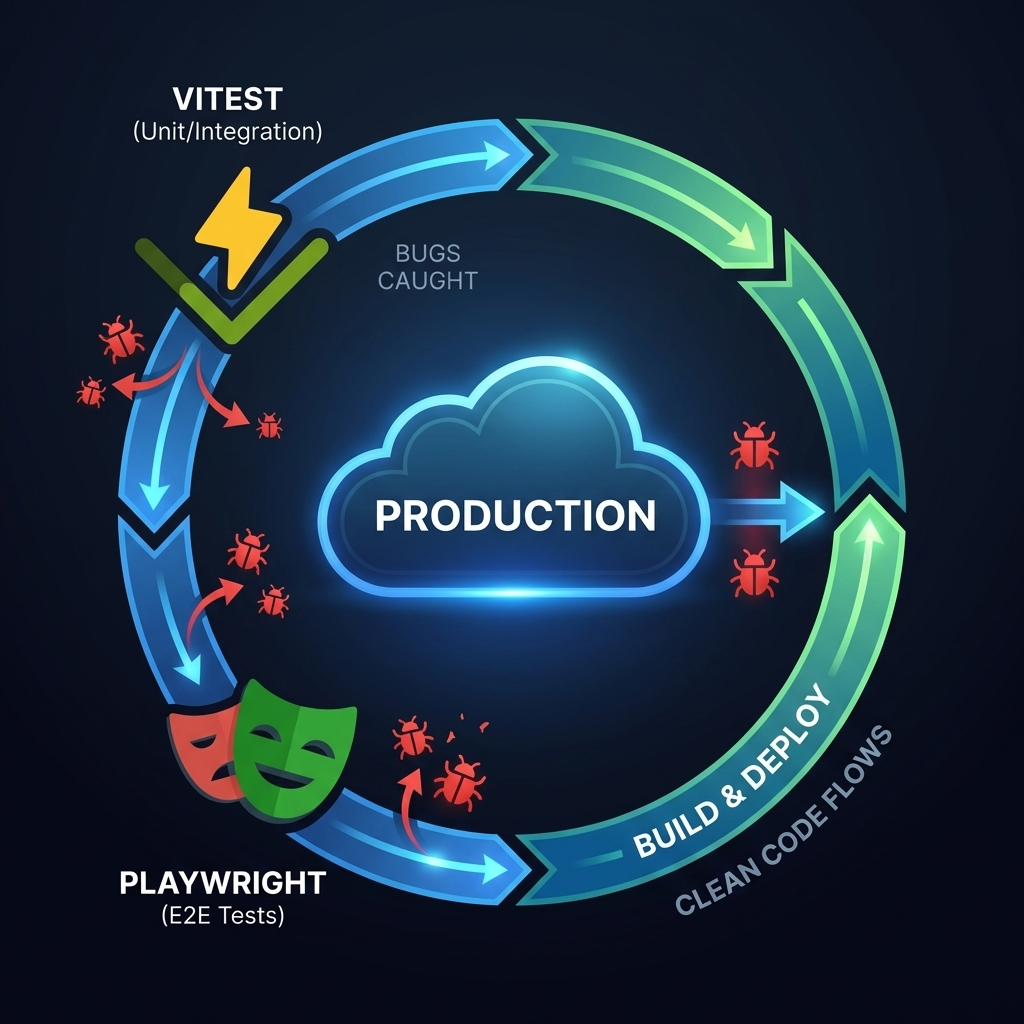
To maintain a high-velocity AI-augmented coding workflow, you need the right tools. We often get asked about the Vitest vs Playwright AI debate. The truth is, you need a multi-layered framework.
- Vitest: This is our “Inner Loop.” It provides sub-second feedback on unit logic. When the AI is building a complex utility or a data transformation function, Vitest ensures the logic is sound before we even look at the UI.
- Playwright: This is our “Outer Loop.” AI is notoriously bad at understanding how a UI feels. Playwright ensures that while the AI is vibing on the backend, it hasn’t accidentally hidden a Submit button or broken the mobile responsiveness.
By combining these, we create AI code quality guardrails that allow us to fulfill projects faster than traditional agencies without the typical AI-generated bugs.
6. Avoiding the Trap of Circular Hallucination
A major reason why self-taught vibe coders fail is because they let the AI write its own tests. If the AI writes the code and then writes the tests to “match” that code, the tests will always pass.
We call this Circular Hallucination. It’s a false sense of security that is devastating for startups.
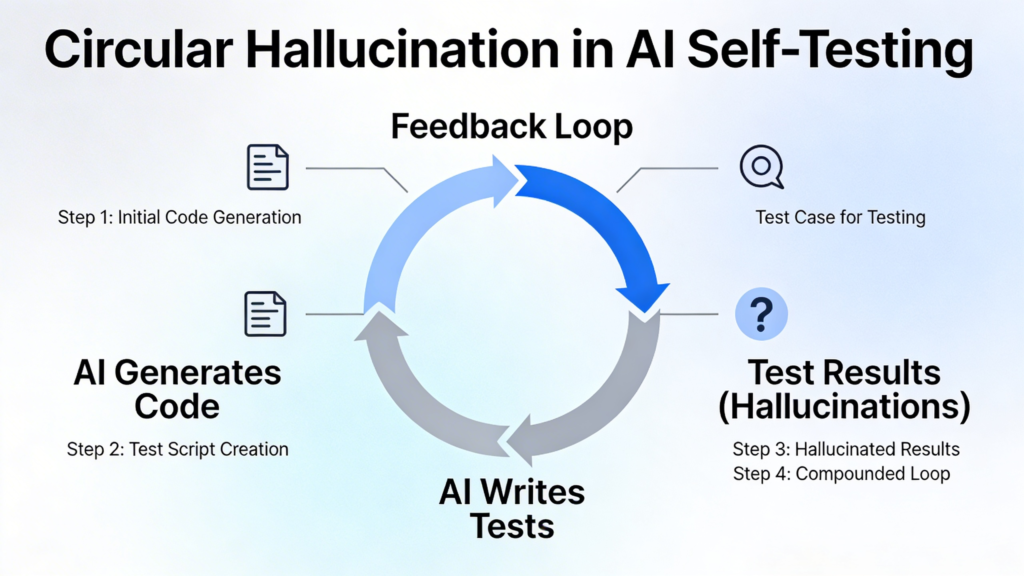
Our automated testing for AI code requires that a human engineer validates the test logic independently of the implementation. This ensures that the “Source of Truth” remains human-verified, while the “Source of Labor” remains AI. This is how we provide AI app fulfillment that actually survives the real world.
7. Scaling the Vibe: Why Your Business Needs Professional Fulfillment
Vibe coding is perfect for a weekend prototype. But if you are building a platform that needs to handle real money and real user data, you need AI app fulfillment that is backed by senior engineering principles.
We’ve seen too many founders hit “The Wall”—the point where their AI-generated app becomes so complex that even the best LLMs can no longer fix the bugs they created. This happens because there was no proven TDD framework to act as safeguards before these bugs were introduced.
At Sleek App, we specialize in taking that initial spark of an idea and turning it into a battle-tested, production-ready application. We use the speed of AI to benefit our clients’ budgets, but we use the rigor of TDD to protect our clients’ data and business.
Ready to Turn Your Vibe Into a Scalable Product?
Vibe coding is the spark, but agentic engineering backed by test driven development is the trustworthy engine.
If you’re tired of hitting The Wall with your AI-generated code, or if you need an AI software development agency that understands the deep trade-offs of modern architecture, let’s talk. Whether you need full-scale app development or specialized custom AI automation services, we have the proven frameworks to ship it right.
Stop vibing. Start engineering.